2026 CR-V Touring Hybrid vs RAV4 Limited: Which Should You Buy?
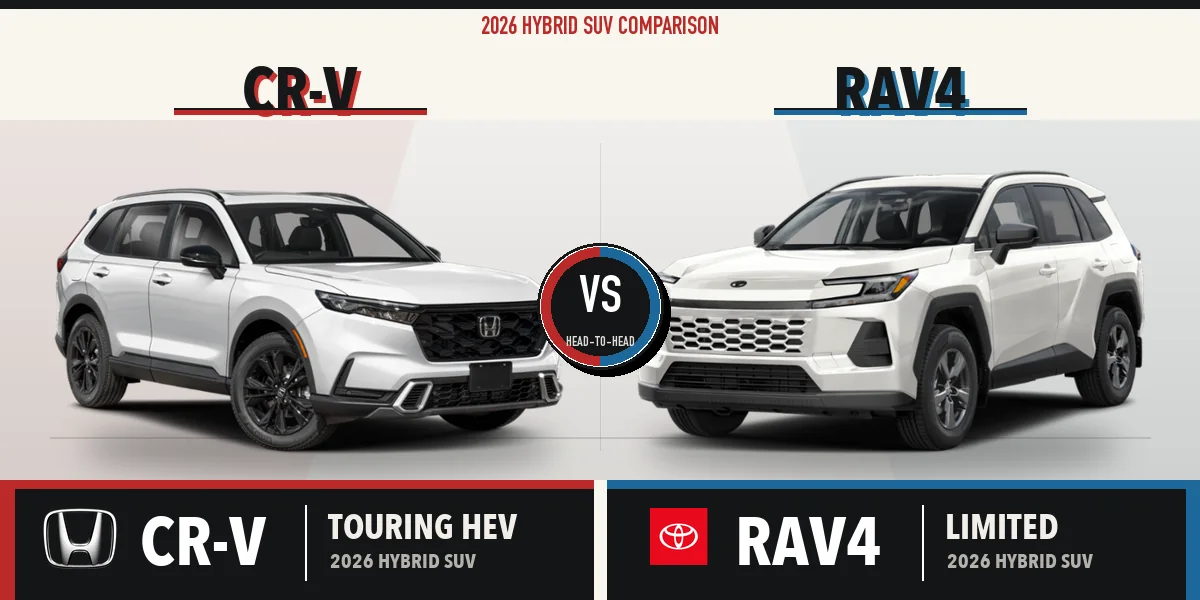
Almost every hybrid shopper I talk to has the same two tabs open. The 2026 Honda CR-V Touring Hybrid and the 2026 Toyota RAV4 Limited sit at the top of their trim ladders, both run all-wheel drive, both sip regular fuel, and both will handle a Canadian winter without drama. The spec sheets look close enough that people freeze.
Drive them back to back and the personalities split fast. One is quicker and packed with screens. The other is the one you stop noticing after a week, in the good way.
I sell Hondas, so read my lean with that in mind. I'll say plainly where the RAV4 beats my own product, and it does in several places.
Which is better, the CR-V Touring Hybrid or the RAV4 Limited?
The 2026 Toyota RAV4 Limited is quicker, more efficient on paper and tows far more. The 2026 Honda CR-V Touring Hybrid is quieter, rides calmer and gives rear passengers noticeably more room. For most Canadian families doing school runs and highway trips, the CR-V is the easier vehicle to live with. Buyers who tow should take the RAV4.
2026 CR-V Touring Hybrid vs RAV4 Limited: specs at a glance
Figures from Honda Canada and Toyota Canada unless noted. Dimensions vary slightly by source and trim.
| Honda CR-V Touring Hybrid | Toyota RAV4 Limited | |
|---|---|---|
| Powertrain | 2.0L Atkinson + two-motor hybrid | 2.5L + 5th-gen Toyota Hybrid System |
| Combined output | About 204 hp | About 236 hp |
| Drive | Real Time AWD with Intelligent Control | Electronic on-demand AWD, rear electric motor |
| Combined fuel rating | 6.4 L/100 km | 5.8 L/100 km (5.4 city / 6.3 hwy) |
| Max towing | About 453 kg (1,000 lb) with package | 1,588 kg (3,500 lb) |
| Length | About 4,695 mm | About 4,600 mm |
| Wheelbase | About 2,700 mm | About 2,690 mm |
| Rear legroom | 1,042 mm | About 960 mm (37.8 in) |
| Cargo, seats up | About 1,028 L | About 1,036 to 1,070 L |
| Cargo, seats folded | About 2,030 L | About 1,994 L |
| Centre screen | 9 in, 10.2 in driver display | 12.9 in |
| Spare tire | No, repair kit only | Yes |
| Roof | Tilt and slide moonroof | Panoramic moonroof |
Powertrain: Toyota hits harder, Honda stays calm
The RAV4's 236 hp system is the stronger one, and you feel it on a merge lane or climbing out of the river valley with four people aboard. Toyota's fifth-generation hybrid setup also delivers the better official rating at 5.8 L/100 km combined for the Limited, against 6.4 for the CR-V Hybrid with AWD.
Honda's two-motor system answers differently. In town it runs as an electric vehicle with the engine acting as a generator, and the handoffs are close to invisible. The drivetrain rarely intrudes on a conversation, and that's the part owners actually notice.
Push either up a long grade and the engine note climbs and stays there. The CR-V drones more at wide-open throttle, the RAV4 sounds coarse when floored. Around town and at 110 km/h both behave beautifully. Load up for mountain passes and the Toyota has the easier job. Honda's paddle-controlled regen is the one control I'd miss, and it earns its keep in stop-and-go and on icy descents.
Fuel economy and the Canadian winter reality
Ratings are measured in ideal conditions. Winter is not ideal conditions.
Hybrids take a bigger cold-weather hit than gas vehicles because the engine has to run to heat the cabin, and short trips never let it reach efficient operating temperature. U.S. Department of Energy research puts hybrid city economy at roughly 30 to 34 percent worse at -7°C than at 25°C, with short trips hurt the most.
CR-V Hybrid owners routinely report 5.5 to 7 L/100 km in mild city driving, then watch it climb to 8 to 12 on January short hops. The RAV4 obeys the same physics, and its paper advantage should carry over, but this generation does not yet have multiple Canadian winters of owner data behind it, and the CR-V Hybrid does. Either way: plan for the penalty and don't judge a hybrid by its first cold week.
Ride and noise: the CR-V's strongest argument
The 2026 RAV4 is a real improvement on the outgoing car. Consumer Reports found it rides more comfortably and more quietly than its predecessor, with added sound deadening and better seals. Fair credit to Toyota, since the old RAV4's choppy ride was its weakest trait.
It still trails the Honda. Edmunds' road trip review measured the 2026 RAV4 as noisier inside than rivals including the CR-V, and flagged road noise as what holds it back over distance. The CR-V's suspension is the more settled of the two over frost heaves, and the Touring's acoustic glass adds to the calm. Drive Highway 2 every week and you notice by the second hour.
Second row and cargo
The CR-V wins the back seat and it isn't close: 1,042 mm of rear legroom against roughly 960 mm. That's the difference between a teenager sitting behind a tall driver in comfort and one complaining the whole way. The CR-V's rear doors open wider and squarer too, which nobody thinks about until they're wrestling a rear-facing seat in a parking stall.
Cargo is a draw: roughly 1,036 to 1,070 L for the RAV4 with the seats up against 1,028 L for the CR-V, and about 2,030 L versus 1,994 L folded. Honda's hybrid packaging leaves the folded floor less than flat, a legitimate gripe if you haul long items or sleep in the back.
One practical note that comes up every single week on my lot: the CR-V Hybrid has no spare tire, only a sealant and compressor kit. That kit handles a small tread puncture and nothing else. A sidewall cut on a gravel road means a tow. The RAV4 Limited includes a spare, and plenty of owners list it as a reason they chose Toyota.
Tech and features
The RAV4 Limited is the more loaded vehicle. Toyota Canada equips it with a 12.9-inch touchscreen, head-up display, Panoramic View Monitor, Advanced Park, a panoramic moonroof, heated and ventilated front seats, heated rear seats, driver's seat memory, a digital rearview mirror and dual wireless charging pads. Its Toyota Safety Sense 4.0 suite adds Traffic Jam Assist, Lane Change Assist and Front Cross Traffic Alert with braking.
The CR-V Touring Hybrid answers with less: a 9-inch screen with Google built-in, a 10.2-inch driver display, wireless CarPlay and Android Auto, perforated leather, heated wheel, heated rear outboard seats, power tailgate and 12-speaker Bose. Climate stays on physical dials, which beats a touchscreen menu with winter gloves on. What it lacks is worth naming plainly: no ventilated seats, no panoramic roof, no surround-view camera, and a reversing camera image owners call mediocre. If those are must-haves, the RAV4 ends the argument.
Neither carries a 2026 IIHS Top Safety Pick. No Toyota SUV earned one this year under the institute's tougher moderate overlap front test, and the CR-V is absent from Honda's 2026 list too. Missing an award isn't failing a crash test, but it's a fair question to put to any salesperson leaning on safety hardware.
What early owners and reviewers are reporting
These are recurring themes in published reviews and owner forums, not a survey I ran. On the CR-V, the missing spare tire is the loudest gripe by a wide margin, followed by the reversing camera image, engine noise on steep grades, interior creaks, a cargo floor that isn't flat with the seats folded, and wiper and washer quirks. The praise is consistent and boring in the way family vehicles should be: a quiet drivetrain around town, low fatigue on long highway days, and heated seats, wheel and rear outboard seats that earn their keep in February.
The loudest ergonomic complaint on the new RAV4 is the right knee hitting the hard plastic edge of the centre console. Edmunds' reviewer called it nearly impossible to position his legs without contact, and taller drivers report it most. Sit in the driver's seat for twenty minutes before you sign anything.
Beyond the knee, RAV4 owners report highway wind noise around the mirrors and roof (inconsistently, car to car), a firmer ride, a lot of hard cabin plastic, ventilated seats that underwhelm on maximum, early software quirks in the head-up display and Android Auto, and connected services moving to a subscription after the trial. What they praise: real acceleration, strong early fuel numbers, the 360-degree camera and self-parking, and the spare tire.
Reliability is the open question, and it cuts both ways. Toyota's hybrid record is excellent, and this RAV4 is built in Woodstock, Ontario, at a plant that has made over four million of them since 2009. But reputation is earned by previous generations. The CR-V Hybrid has several Canadian winters of owner data behind this powertrain. The new RAV4 does not yet.
Who should buy which
Buy the 2026 Honda CR-V Touring Hybrid if you carry adults or car seats in the second row, you drive long highway stretches, and you'd take a quiet cabin over a longer feature list. You're giving up ventilated seats, a panoramic roof and the spare tire.
Buy the 2026 Toyota RAV4 Limited if you tow, you want the stronger engine and the better fuel rating, or the head-up display, surround-view camera and self-parking are must-haves. Confirm the knee clearance on the exact car you're taking home.
Splitting hairs with no clear priority? The CR-V asks less of you every day, and asking less is what people keep for eight years.
Shopping these two? Send me your priorities and I'll tell you which trim makes sense for how you actually drive.
FAQ
Which one holds its value better?
Both hold up unusually well, which is why used examples of either sit close to new-car money. Toyota's resale reputation is stronger in the abstract, but in this pair the gap is small enough that condition, colour and accident history move the number more than the badge does.
Which one is better in snow?
Both are effective and it's close to a tie. Honda uses Real Time AWD with Intelligent Control and a mechanical rear coupling, while Toyota uses an on-demand system with a dedicated rear electric motor. Winter tires will make a far bigger difference than the AWD hardware on either vehicle.
Does the 2026 CR-V Hybrid have a spare tire?
No. Hybrid CR-V models carry a sealant and compressor repair kit instead, because the battery occupies the spare well. The kit handles small tread punctures only. The RAV4 Limited includes a spare tire, which is a frequent reason buyers choose it.
How much can each one tow?
The RAV4 Limited is rated at 1,588 kg (3,500 lb). The CR-V Touring Hybrid is rated at roughly 453 kg (1,000 lb) with the towing package. If you tow anything meaningful, this comparison is already over.
Do either of them need premium fuel or a special winter routine?
Neither needs premium fuel. A block heater is optional rather than required on both, since a hybrid starts on the electric side, but there's still a gas engine in there and in deep cold a heater will ease the start and shorten warm-up. Expect a real winter fuel penalty either way.
Should I worry that the 2026 RAV4 is an all-new design?
It's worth considering rather than worrying about. Early software quirks are common on any new platform, and this generation has no long-term Canadian reliability record yet. Toyota's hybrid history is strong, but that history was earned by earlier generations.
The bottom line
Nobody making either choice is making a mistake. Drive them on the same afternoon on the same roads and you'll feel which one you want inside ten minutes.
Book them back to back. Bring the car seat, bring the family, and sit in the back seat before you sit in the driver's seat.
Sources: Honda Canada, Toyota Canada, Toyota Canada media release on Woodstock production, Consumer Reports 2026 RAV4 road test report, Edmunds 2026 RAV4 road trip review, Cars.com on 2026 IIHS Toyota SUV results, IIHS 2026 Top Safety Pick listings, U.S. Department of Energy fuel economy cold weather research, and owner forums.